
Conservation, culture, and the classroom: Place-based education for cultural continuity
Christopher Liberty

Digital Object Identifier (DOI)
This article examines how conservation can disrupt indigenous Batwa cultural systems and marginalise traditional ecological knowledge, drawing on scoping fieldwork in Southwestern Uganda. It argues that place-based education can support cultural continuity by recognising traditional ecological knowledge as embodied and relational, rather than anecdotal. The article proposes a rights-based approach grounded in community ownership, intergenerational learning, and curriculum co-design, while emphasising safeguards against knowledge extraction.
Introduction
I grew up in a part of Uganda where rainfall was never simply about weather. When drains clogged and water turned brown, it carried disease and danger. After downpours, we waded through refuse and queued at the public hospital with neighbours to receive treatment for waterborne illnesses. These early experiences continue to shape the questions I return to as an education practitioner and emerging researcher: who decides what counts as traditional knowledge, whose voices shape school learning in times of climate emergency, and can the curriculum repair rather than reproduce the harms of epistemic exclusion? (Mbah & Ezegwu, 2024).
Those questions travelled with me to Southwestern Uganda in late 2025, when I joined a University of Leeds-linked visit that brought together curriculum conversations and lived ecologies. The School of Education team visited Uganda’s National Curriculum Development Centre (NCDC) to contribute to British Academy writing workshops and then visited indigenous Batwa communities and the mountain gorillas native to that landscape, alongside local schools, to understand how traditional ecological knowledge is perceived, valued, and taught (see more here). These experiences further challenged my assumptions and prompted a rethinking of key ideas, which I articulate throughout this article.
When conservation disrupts culture
During our scoping fieldwork, an indigenous Batwa youth described how his parents were removed from the forest in 1991 (Kokunda et al., 2023). In the same breath came the consequence: culture loss. Another line followed quickly, almost like a list learned by repetition. Traditional food had been wild honey, forest vegetables, fruits, and animal meat. After eviction, that food system was no longer available in the same way, and farming became a necessity rather than a continuation of practice.
An interaction with an elderly woman who experienced life in the forest before eviction was even more revealing. She remembered being chased with guns from the forest, without understanding why, and without meaningful compensation or resettlement support. In her words, the removal did not simply relocate people; it reordered power and hunger. “The government removed [us] from the forest and didn’t give us any support. We are always hungry,” she said, adding that visitors often become the only reliable point of support for food.
These testimonies sit alongside a wider debate about exclusionary conservation, rights, and justice, embodying an inherent tension: conservation interventions can protect biodiversity while simultaneously severing the social and cultural infrastructures that make life coherent. So where does education fit? Not as a substitute for land rights, restitution, or political repair. Curriculum cannot replace justice. But education does shape what is remembered, what is valued, what is made teachable, and what becomes possible to pass on (Berkes, 2017).
What place-based education offers, especially after displacement
Place-based education is often described as learning rooted in local ecologies, community histories, and lived experience. It is sometimes treated as a pedagogical technique (Ajaps et al., 2022). In contexts like Bwindi-Mgahinga, it is closer to a survival strategy for cultural continuity. The question is not only how pupils learn about forests, but also how forest-connected people continue to learn about themselves when access to ancestral places is restricted or mediated through tourism, regulation, and external expertise.
This is where a critical pedagogy of place matters: it asks us to notice how place is produced through power, and how education can either deepen displacement or support re-connection in ethically grounded ways. It also aligns with decolonial environmental education and communication, which challenges minority-world dominated frameworks that fail to reflect indigenous values, governance, and meaning-making (Sherpa, 2017).
In the indigenous Batwa context, the goal is not to romanticise forest knowledge or extract it for the purpose of generating classroom content. The goal is to document the traditional ecological knowledge carried by language, elders, livelihoods, spirituality, and relationships. Our interactions with Batwa people further demonstrate that this traditional ecological knowledge is not superficial; it is detailed, embodied, and ecological (Nesterova, 2020).
Indigenous Batwa knowledge is not merely anecdotal, it constitutes a curriculum
One elder explained how time could be read from shadows in broad daylight, and how cloudy conditions changed the ability to see time that way. She also spoke about animals from the monkey family, Ebirema, signalling the late afternoon hour. Another sign of season change – a swarm of black ants “that attacked us everywhere” – was taken as a predictor of rainfall or floods. These are not superstitions. They are long-term observations, encoded in practice, and tied to safety, food, and movement.
Honey, too, emerged not only as a symbol of memory but also of deeply embodied knowledge. The elder described honey from wood (bees) and from the ground, and noted how land-use change affected what was still available. She linked this loss to neighbours’ agricultural expansion. Later, she specified three types of honey, naming them and distinguishing where they are found. She also described practices whereby honey was given to gorillas and how, in turn, the gorillas would respond with deep, rumbling belches to communicate contentment and satisfaction.
The indigenous Batwa people’s relationship with gorillas is especially revealing for conservation education. In the past, gorillas were not seen as prey but rather as kin-like beings (Ampumuza, 2022). One account described offerings: honey placed in a calabash with meat beside it, in a designated space behind homes. The same elder insisted that gorillas did not attack the indigenous Batwa people, and that their presence could deter other animals. In a conversation with pupils at Rushaga Community School, some indigenous Batwa pupils said that they feared gorillas, referring to them as “enyamaishwa ezirikubirya” – wild animals that can attack them. This not only signifies the loss of the symbiotic relationship the indigenous Batwa have always enjoyed with gorillas but also cultural loss among the indigenous Batwa.
If conservation efforts are only focused on population numbers, threats, and park rules, we miss a whole moral ecology of coexistence. A moral ecology respects how people interpret conservation, compliance, and belonging. Place-based education can make that moral ecology teachable, without turning it into a commodity (Pan, 2022). As such, when conservation displaces people from place, the curriculum can either reinforce erasure or serve as a vital tool for cultural continuity.
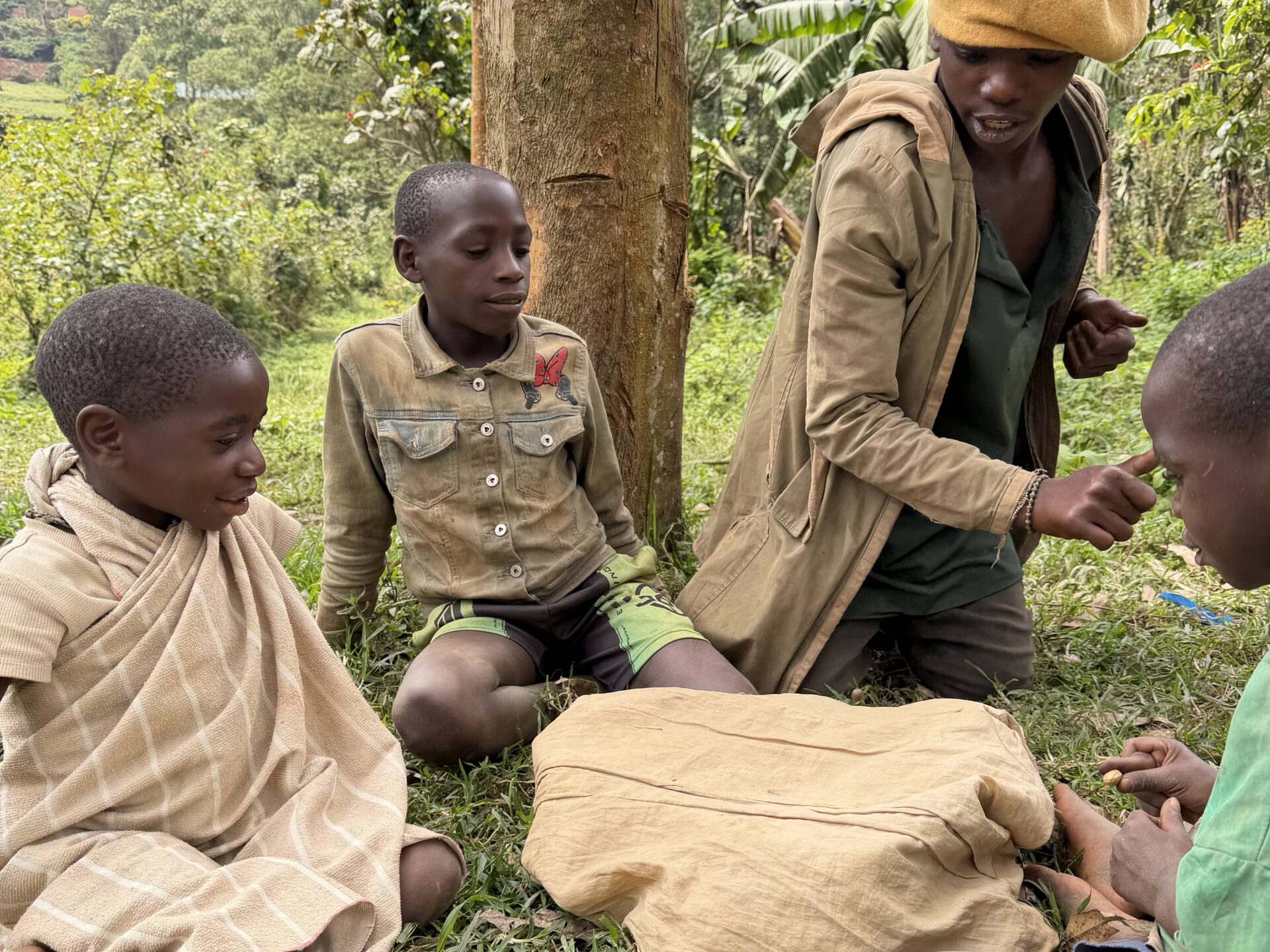
Indigenous Batwa children in Rushaga utilise natural resources as tools for play.
A rights-based model of place-based education
What would this approach look like? A rights-based model of place-based education would be grounded in decolonising methodologies, dialogic ethics, and curriculum co-design. It would be motivated by the need to repair epistemic exclusion through education, rather than using education to polish the language of inclusion while keeping the structure of exclusion intact (Gómez-Baggethun & Reyes-García, 2013; Mbah & Liberty, 2025). In practical terms, that involves a few commitments.
Community ownership and knowledge governance
If indigenous Batwa knowledge enters the curriculum, questions arise about what can be shared, what must remain protected, what requires ceremony or contextualisation, and what should not be assessed or standardised. This foregrounds the importance of working with community protocols for knowledge governance and consent, alongside participatory action research and indigenous methodologies (Mat Noor, 2024).
Intergenerational learning as a design principle
Interactions with the Batwa people made it clear that elders hold vital traditional ecological knowledge (Breidlid, 2009). However, intergenerational learning is not automatic in contexts shaped by displacement, poverty, and stigma. Place-based education can create respectful pathways for elders to teach, in ways that are compensated, safeguarded, and shaped by community preference rather than external convenience.
Curriculum co-design with teachers
During the University of Leeds visit to Uganda, the NCDC workshops highlighted curriculum design and co-design approaches involving pupils and teachers. This matters because the barrier is rarely a lack of teacher interest; rather, teachers often face limited time, scare resources, and strong pressure to prioritise assessable content. Co-design reframes the issue: instead of asking teachers to insert indigenous Batwa traditional ecological knowledge into an already crowded syllabus, it asks what kind of curriculum is ethically defensible in indigenous Batwa-adjacent schools (Mat Noor et al., 2025).
Curricular space for traditional ecological knowledge
The goal is not to make indigenous Batwa traditional ecological knowledge conform to Western scientific frameworks. Instead, it is to create legitimate curricular space where different ways of knowing can coexist without one being reduced to illustrative local examples of the other (Massey & Kirk, 2015).
Importantly, a curriculum-oriented approach towards continuity requires assessment practices that can recognise and practise relational accountability. This may include portfolios, community-validated learning artefacts, seasonal calendars developed with elders, reflective writing in local languages, or oral assessments that align with indigenous pedagogies. Even within systems that require standardised assessment, there remains scope to broaden what counts as an achievement.
What might this look like in an indigenous Batwa-adjacent school?
In practice, a rights- and place-based curriculum could begin with seasonal traditional ecological knowledge and climate literacy. Pupils might document local signs of rain and seasonal shifts, including the indigenous Batwa elder’s account of black ants as predictors of rainfall, and compare these observations with meteorological explanations. The pedagogical aim should not be to validate indigenous observation through scientific frameworks, but to explore how different systems interpret environmental change and uncertainty (Mat Noor & Roslan, 2025).
A second dimension involves teaching the ethics of conservation through relational narratives. Lessons on gorilla conservation could incorporate Batwa accounts of coexistence, including non-hunting norms and practices of offering honey. These narratives could be situated within broader discussions on stewardship, kinship with non-human beings, and the political dimensions of protected areas, enabling pupils to engage with conservation beyond technical or regulatory perspectives.
Finally, food systems could be approached as a lens into history and political ecology. Pupils could trace the transition from forest-based foods systems, such as wild honey, forest vegetables, fruits, and meat, to current livelihood constraints. This shift would provide an entry point into examining land tenure, nutrition, and development ethics. Integrating ecological vocabulary, including terms related to honey types and seasonal practices, is also crucial, as language functions not only as a medium of learning but as a vital component of what is being sustained.
Closing thoughts
There is a real danger that integrating traditional ecological knowledge into education becomes another form of extraction. Safeguards, therefore, are not optional but essential. These include consent processes that recognise traditional ecological knowledge as collectively governed approaches to knowledge creation that align with indigenous Batwa cultural expression – such as community-owned curriculum frameworks and participatory documentaries, rather than solely academic outputs; clear decisions about what should remain off-limits, particularly sacred knowledge; and the development of long-term partnerships with indigenous Batwa-led organisations and teachers.
Conservation and education often meet in the language of awareness. However, indigenous Batwa narratives push us beyond awareness to accountability. When people are removed from the forest for preservation and protection, the forest may be protected, but this alone is not enough. Place-based education cannot undo the damage done to communities, but still, it can refuse to complete the erasure. It can create structured pathways for cultural continuity, for intergenerational teaching, for language survival, and for conservation itself to be rethought through relationship rather than exclusion. And if we take seriously the question of who decides what counts as traditional ecological knowledge, then the curriculum is not just administrative, it is power.
References
Ajaps, S., Mbah, M. F., & Mbah, M. (2022). Towards a critical pedagogy of place for environmental conservation. Environmental Education Research, 28(4), 508–523. https://doi.org/10.1080/13504622.2022.2050889
Ampumuza, C. (2022). Living with Gorillas? Lessons from Batwa-gorillas’ convivial relations at Bwindi Forest, Uganda. Conservation and Society, 20(2), 69-78. https://doi.org/10.4103/cs.cs_30_21
Berkes, F. (2017). Sacred Ecology (4th ed.). Routledge. https://doi.org/10.4324/9781315114644
Breidlid, A. (2009). Culture, indigenous knowledge systems and sustainable development: A critical view of education in an African context. International Journal of Educational Development, Education and Sustainable Development, 29(2), 140–148. https://doi.org/10.1016/j.ijedudev.2008.09.009
Gómez-Baggethun, E., & Reyes-García, V. (2013). Reinterpreting change in traditional ecological knowledge. Human Ecology, 41(4), 643–647. https://doi.org/10.1007/s10745-013-9577-9
Kokunda, S., Nahabwe, H., Nahamya, J., Niwamanya, S., Mazirwe, R., Gougsa, S., Kemigisha, E., & Redvers, N. (2023). Batwa Indigenous Peoples forced eviction for “Conservation”: A qualitative examination on community impacts. PLOS Global Public Health, 3(8), e0002129. https://doi.org/10.1371/journal.pgph.0002129
Massey, A., & Kirk, R. (2015). Bridging Indigenous and western sciences: Research Methodologies for traditional, complementary, and alternative medicine systems. Sage Open, 5(3), 2158244015597726. https://doi.org/10.1177/2158244015597726
Mat Noor, M. S. A., & Roslan, R. (2025). An exploration of Iban communities’ indigenous funds of knowledge as an imperative resource for the STEAM curriculum-making process in Brunei Darussalam. Cultural Studies of Science Education, 21, 1-32. https://doi.org/10.1007/s11422-025-10265-3
Mat Noor, M. S. A., Mohd Roslan, R., Mohd Said, H., & Md Johari, M. (2025). Incorporating indigenous and local knowledge (ILK) into a climate change curriculum in Brunei Darussalam. In W. L. Filho, M. Sima, A. L. Salvia, M. Kovaleva, & E. Manolas (Eds.), University Initiatives on Climate Change Education and Research (pp. 1-31). Springer. https://doi.org/10.1007/978-3-031-25960-9_99-1
Mbah, M. F., & Ezegwu, C. (2024). The decolonisation of climate change and environmental education in Africa. Sustainability, 16(9), 3744. https://doi.org/10.3390/su16093744
Mbah, M. F., & Liberty, C. (2025). Why education matters for a climate-resilient Africa. In M. F. Mbah, P. Molthan-Hill, & E. L. Molua (Eds.), Practices, Perceptions and Prospects for Climate Change Education in Africa (pp. 19–39). Springer. https://doi.org/10.1007/978-3-031-84081-4_2
Nesterova, Y. (2020). Rethinking environmental education with the help of indigenous ways of knowing and traditional ecological knowledge. Journal of Philosophy of Education, 54(4), 1047–1052. https://doi.org/10.1111/1467-9752.12471
Pan, Y. (2022). On ethics of coexistence between man and nature. Academic Journal of Humanities & Social Sciences, 5(3). https://doi.org/10.25236/AJHSS.2022.050320
Sherpa, P. D. (2017). Interfacing indigenous knowledge and climate change education. Journal of Education and Research, 7(1), 52–64.