
Exploring children’s traditional ecological knowledge through creative, arts-based approaches
Nurfatin Nadia Mohd Suhaimi

Digital Object Identifier (DOI)
This blog explores how drawing can be used to uncover children’s traditional ecological knowledge and cultural connections to the environment. It summarises three case studies showing how arts-based approaches reveal the myriad ways children understand and represent nature. For instance, children depict scenes of life by the sea, forest activities and diverse cultural perspectives. Together, these studies highlight how art helps children express what they know and feel about their surroundings, offering valuable insights into traditional ecological knowledge and cultural understanding.
Traditional Ecological Knowledge (TEK) refers to the cumulative body of knowledge, practices and beliefs that evolve through adaptive processes and are transmitted across generations (Berkes, 2018). It encompasses not only ecological understanding but also the values, ethics and cultural traditions that guide how communities interact with their environment, representing the accumulated wisdom of indigenous and local peoples (Zidny et al., 2021). To explore such rich and holistic knowledge systems, it is essential to use approaches that are meaningful and accessible to children. Creative, arts-based methods such as drawing, storytelling and narration allow children to express their understanding visually and emotionally while reinforcing their cultural ties to the environment (Fache et al., 2022; Mustapa et al., 2022; Monteira et al., 2024). Combining drawings with interviews and narration has proven especially valuable, as it enables children to communicate emotions, thoughts and tacit knowledge that might otherwise remain unspoken (Kamarudin & Mat Noor, 2024).
Drawing as a window into ecological knowledge
Children’s drawings, in particular, are a valuable research tool. They serve as a visual language that communicates ideas that children may not yet be able to articulate in words. Drawings provide insights into how children perceive nature, which is crucial for engaging them with local wildlife and addressing the growing disconnect between children and the natural world (Howlett & Turner, 2023). Drawings further serve as valuable indicators of children’s ecological knowledge, revealing the animals and plants they are most familiar with, highlighting gaps in their awareness and providing insights into whether they experience a sense of belonging to their environment, which is essential for fostering connections with nature and encouraging sustainable behaviours (Sanchis et al., 2022).
Analysing these visual expressions provides researchers with nuanced insights into how children perceive and interpret natural phenomena, including their understanding of plant life (Goodwin, 2016) and animals (Villarroel et al., 2018). Children’s drawings carry meaning because they show how children interpret both their inner world and the environment around them. As Kipouropoulou (2020) notes, drawings are “semiotic acts” that reflect cultural and social influences, as children use symbols and images to construct and communicate meanings shaped by their everyday experiences and the contexts in which they live. For example, the way they depict nature, family or community often mirrors the cultural values, practices and modern influences they experience, revealing how they understand and interpret the world around them. All of the aforementioned research highlights the value of drawings as a research tool when working with children.
In exploring creative and participatory ways to understand how children connect with their environment, researchers have increasingly turned to arts-based methodologies such as drawing and storytelling (Gal & Gan, 2021; Sanchis et al., 2022; Yuliarini & Pamungkas, 2025). These approaches are especially valuable when working with indigenous and rural communities (Profice (2018), where knowledge is deeply rooted in lived experiences and sustained through oral traditions, the arts, rituals and daily practices (Li & Han, 2022).The following case studies from diverse regions provides an example of how drawing can serve as both a research tool and a medium for expressing TEK.
Fache et al. (2022) studied children in Fiji and New Caledonia, showing how their drawings and interviews reflected local ways of viewing and living with the sea. Carrière et al. (2017) worked with children in Gabon and Madagascar to show how drawings can reveal and preserve TEK. Meanwhile, Profice (2018) compared children’s drawings in Brazil and New York, showing how cultural background shapes whether nature is seen as alive and connected or distant and fragile. Together, these studies show that creative, arts-based approaches help uncover how children experience and represent their environment.
Case study 1: Research on marine environments in Fiji and New Caledonia: Encouraging children to draw
Fache et al.’s (2022) study adopted an arts-based, participatory approach to explore how children perceive and experience their local marine environment. It involved 290 children aged 9 to 15 from urban, rural and coastal schools in the coastal and island communities of Fiji and New Caledonia. Combining drawing with short interviews provided an inclusive and culturally grounded way to access children’s local ecological knowledge.
Children were invited to respond to the open-ended prompt: “Draw the sea and what you and others do in the sea.” This simple yet powerful task encouraged them to depict everyday human activities, marine species and environmental features based on personal and communal experience. The follow-up interviews allowed participants to discuss their drawings, offering deeper insights into the meanings, emotions and observations behind their visual representations.
The study found that the methodology effectively bridged verbal and visual expression, allowing researchers to capture how children conceptualised marine life and human-nature relationships. The drawings revealed both the cultural and regional differences that led Fijian children to emphasise fishing activities, family cooperation and community life, and children from urban New Caledonia to depict leisure activities such as swimming and sailing, thus reflecting differing relationships with the sea.
Through this approach, Fache et al. (2022) demonstrated that drawing functions not only as a participatory method but also as an epistemological tool. It allows children to translate lived, sensory experience into visual narratives, positioning them as co-producers of ecological knowledge. The study highlights the potential of arts-based methodologies to bridge Western scientific perspectives and local worldviews, promoting more inclusive and culturally responsive forms of environmental research.
A child’s drawing depicting elements of the natural environment, reflecting their ecological understanding and connection to nature.
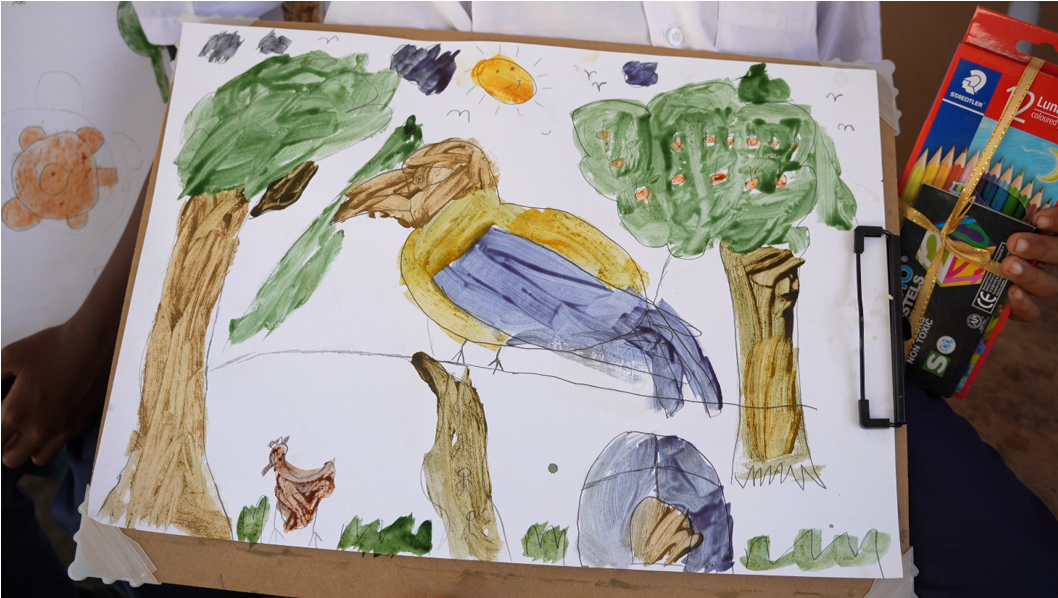
A child’s drawing depicting elements of the natural environment, reflecting their ecological understanding and connection to nature.
Case study 2: Drawing as a tool for ethnoecologists to collaborate with children in Gabon, Madagascar
Carrière et al.’s (2017) study explored how children’s drawings can serve as an innovative method for documenting Traditional Ecological Knowledge (TEK). While ecological research has traditionally focused on adult knowledge, this study repositioned children as active participants in ecological learning and cultural transmission. Using art as both a methodological and analytical tool, the researchers examined how children represent, internalise and communicate their understanding of the natural world. Conducted between 2004 and 2006 in Gabon and Madagascar, the study involved over 300 children aged 9 to 13 from rural and coastal communities. The research aimed to document children’s ecological knowledge and to assess the effectiveness of children’s drawings as an ethnoecological tool.
The methodology combined drawing sessions with individual informal interviews. Children were asked to “draw nature, your nature, your environment” and later explained their artwork to the researchers by identifying the species shown, describing the ecosystems and interactions depicted and sharing the reasons and cultural meanings behind their representations. The visual data were then analysed alongside ethnographic observations to identify key domains of ecological knowledge, including species identification, ecosystem understanding, subsistence practices and cultural uses of plants and animals. Rather than relying on quantitative methods such as free listing (Gallois et al., 2023; Setalaphruk & Price, 2007) and cultural consensus analysis (Johns et al., 1990), the researchers emphasised the heuristic and interpretive value of drawings as a tool to access children’s tacit and experiential knowledge. Drawings were collected and analysed qualitatively to identify recurring ecological elements, symbolic representations and relationships between humans, animals and landscapes.
The study found that children from the Merina and Betsileo highland regions of Madagascar produced distinct ecological depictions. The Merina children, living near urban areas, illustrated agricultural landscapes, exotic plantations and livestock rearing. In contrast, the Betsileo children near Ranomafana National Park focused on forest-based activities such as hunting, fishing and foraging. Similarly, in Gabon’s Nyanga region, coastal children drew lagoons, boats and marine species, showing that fishing and trade are central to daily life. Across all sites, drawings revealed nuanced ecological knowledge and gendered patterns. Boys often portrayed fishing and forest activities, whereas girls focused on domestic or market scenes. Many artworks displayed ecological precision through accurate species forms, habitat details and multilingual species names, which reflected both practical experience and early cultural learning.
Overall, the study demonstrates that children’s drawings are a powerful ethnoecological tool bridging verbal and non-verbal knowledge. They offer researchers access to children’s internalised understandings of their environment, particularly in contexts where linguistic or cultural barriers limit expression. The integration of drawings with interviews and ethnographic observation highlights how child ethnoecology can enrich TEK research, tracing how ecological knowledge is learned, shared and transformed across generations.
Case study 3: Nature as a living presence: Drawings by children from Tupinambá and New York
Profice’s (2018) study explored how children from different cultural and ecological backgrounds perceive and represent nature through art and narrative. Conducted with Tupinambá indigenous children in Brazil and urban children in New York City, the research aimed to understand whether children view nature as a living, interconnected presence or as a separate, utilitarian entity. A total of 91 children from Tupinambá and 53 from New York aged 6 to 14 were asked to draw nature scenes and take part in short interviews describing their drawings and feelings towards nature.
The methodology combined both visual and verbal data, allowing researchers to analyse quantitative elements such as the number of humans, plants, animals, celestial and man-made objects, and qualitative features, including “liveliness” (movement or interaction) and “animism” (facial or emotional traits in non-human beings). This dual approach enabled the study to explore not just what children know about nature, but how they emotionally and culturally relate to it.
Findings revealed clear contrasts between the two groups. Tupinambá children displayed deep ecological awareness and biodiversity knowledge, depicting diverse animals, rivers and forests as integral to everyday life. Their drawings often conveyed motion and interconnectedness, expressing nature as alive and relational. In contrast, The New York children’s drawings tended to show fragmented or polluted environments, with nature often portrayed as distant or fragile.
Profice’s (2018) study demonstrates how arts-based methods, particularly the combination of drawing and narrative, serve as effective tools for accessing children’s ecological worldviews. By translating cultural experience into visual and emotional expression, the methodology provides valuable insights into how children understand, value and imagine their relationship with the natural world.
Conclusion
Across these three case studies from the marine worlds of Fiji and New Caledonia (Fache et al., 2022) to the forested landscapes of Gabon and Madagascar (Carrière et al., 2017) and the contrasting cultural ecologies of Brazil and New York (Profice, 2018), children’s drawings emerge as a vital medium for expressing ecological knowledge. Their artwork, which represents sea life, forest activities and spiritual relationships with nature, reveals how their lived experiences, cultures and local places shape their understanding of the environment. Collectively, these studies show that drawing is not simply a creative or pedagogical exercise but a powerful way of knowing that bridges observation, emotion and memory while validating children’s voices in ecological research (Carrière et al., 2017; Fache et al., 2022; Profice, 2018). It is imperative to recognise visual expression as legitimate data to enable ecological research to become more participatory, decolonial and inclusive. This approach reminds researchers and educators that the future of ecological knowledge lies in listening to and learning from the youngest voices.
References
Berkes, F. (2018). Sacred ecology (4th ed.). Routledge. https://doi.org/10.4324/9781315114644
Carrière, S. M., Sabinot, C., & Pagezy, H. (2017). Children’s ecological knowledge: drawings as a tool for ethnoecologists (Gabon, Madagascar). AnthropoChildren, 7(7). https://doi.org/10.25518/2034-8517.2777
Fache, E., Sabinot, C., Pauwels, S., Riera, L., Breckwoldt, A., David, G., Matairakula, U., & Carrière, S. M. (2022). Encouraging drawing in research with children on marine environments: methodological and epistemological considerations. Human Ecology, 50(6), 739–760. https://doi.org/10.1007/s10745-022-00332-6
Gal, A., & Gan, D. (2021). Imagine a school: children draw and explain the ideal environmental school. Australian Journal of Environmental Education, 37(3), 208–223. https://doi.org/10.1017/aee.2021.3
Gallois, S., Duda, R., & Reyes-García, V. (2023). Local ecological knowledge among Baka children: a case of “children’s culture” ? Journal of Ethnobiology, 37(1), 60-80. https://doi.org/10.2993/0278-0771-37.1.60
Goodwin, T. (2016). Educating for ecological literacy. The American Biology Teacher, 78(4), 287–291. https://doi.org/10.1525/abt.2016.78.4.287
Howlett, K., & Turner, E. C. (2023). What can drawings tell us about children’s perceptions of nature? PLoS One, 18(7), e0287370. https://doi.org/10.1371/journal.pone.0287370
Inwood, H. (2008). At the crossroads: situating place-based art education. Canadian Journal of Environmental Education, 13(1), 29–41. https://cjee.lakeheadu.ca/article/view/871?utm
Johns, T., Kokwaro, J. O. & Kimanani, E. K. (1990).Herbal remedies of the Luo of Siaya District, Kenya: establishing quantitative criteria for consensus. Economic Botany, 44, 369–381. https://doi.org/10.1007/BF03183922
Kamarudin, M. Z., & Mat Noor, M. S. A. (2024). To what extent do primary school children understand photosynthesis?: a study of children’s drawings with follow-up interviews, Education, 3-13. https://doi.org/10.1080/03004279.2024.2385434
Kipouropoulou, E. (2020). Children’s drawings and the grammar of visual design: pedagogical application of the depiction of the “other” in pre-school children’s drawings. Multilingual Academic Journal of Education and Social Sciences, 8(1), 131–150. http://doi.org/10.46886/MAJESS/v8-i1/7274
Li, J., & Han, F. (2022). Strong ethics and flexible actions, the properties of traditional ecological knowledge (TEK), as key resources for socio-ecological resilience to the impacts of climate change: a case study of Baojiatun, Yunnan-Guizhou Plateau karst area, southwest China. Ecology and Society, 27(4), 31. https://doi.org/10.5751/ES-13400-270431
Monteira, S. F., Jiménez-Aleixandre, M. P. & Martins, I. (2024). Cultural semiotic resources in young children’s science drawings. Cultural Studies of Science Education, 19, 295–315. https://doi.org/10.1007/s11422-024-10214-6
Mustapa, N. D., Mohd Nasir, M. R., Mohd Jain Noordin, M. A., & Arminda, W. (2022). Rural children’s perceptions and definitions of nature. Environment-Behaviour Proceedings Journal, 7(21), 11–16. https://doi.org/10.21834/ebpj.v7i21.3703
Profice, C. (2018). Nature as a living presence: drawings by Tupinambá and New York children. PLoS ONE, 13(10). https://doi.org/10.1371/journal.pone.0203870
Sanchis, A. C., Ferrandis, I. G., & Gómez, J. G. (2022). The perception of the environment through drawing in early childhood education: the case of the wetland of the Albufera in Valencia (Spain). Journal of Outdoor and Environmental Education, 25, 265-287. https://doi.org/10.1007/s42322-022-00101-5
Setalaphruk, C., & Price, L. L. (2007). Children's traditional ecological knowledge of wild food resources: a case study in a rural village in Northeast Thailand. Journal of Ethnobiology and Ethnomedicine, 3(1), 3-33. https://doi.org/10.1186/1746-4269-3-33
Villarroel, J., Antón, A., Zuazagoitia, D., & Nuño, T. (2018). A study on the spontaneous representation of animals in young children’s drawings of plant life. Sustainability, 10(4), 1000. https://doi.org/10.3390/su10041000
Yuliarini, S., & Pamungkas, J. (2025). Nature-based art learning: a strategy to develop aesthetic experience and ecological awareness in children aged 5–6 years. Journal of Educational Sciences, 9(3), 1742–1753. https://doi.org/10.31258/jes.9.3.p.1742-1753
Zidny, R., Solfarina, S., Aisyah, R. S. S., & Eilks, I. (2021). Exploring indigenous science to identify contents and contexts for science learning in order to promote education for sustainable development. Education Sciences, 11(3), 114. https://doi.org/10.3390/educsci11030114
10.48785/100/378 (pdf), File Download
Author
Nurfatin Nadia Mohd Suhaimi
Research Assistant, Universiti Kebangsaan Malaysia