
The creative and arts-based fieldwork phase has now begun

From 10th to 19th April 2025, Voices of the Rainforest conducted the first component of its creative and arts-based fieldwork across five partner schools in the states of Kelantan, Pahang, and Perak, Malaysia. These schools are situated in rainforest areas, some located as far as 400 kilometres from Kuala Lumpur. Reaching them required a variety of transport modes, including four-wheel drive vehicles to traverse unpaved and uneven roads, as well as boat journeys along lakes and rivers—some of which passed through dense rainforests.
All principal researchers and eight research assistants from the University of Leeds and Universiti Kebangsaan Malaysia collaborated on the fieldwork to explore the intergenerational transmission of traditional ecological knowledge and climate-related understanding among primary school children aged 7 to 12. The fieldwork also aimed to build the capacity of research assistants by offering hands-on experience in creative and arts-based research methods, engagement with indigenous communities, and involvement in data collection, documentation, and preliminary analysis.

Nurfatin Nadia Mohd Suhaimi, a research assistant, is leading the workshop by guiding the children through a structured process of creative and arts-based data collection.
The fieldwork began with a pilot study involving a group of indigenous children in Kampung Sungai Rual, located in the district of Jeli, Kelantan. Following analysis of the pilot study and subsequent revisions to the research protocol, the team conducted the main data collection across five primary schools, allocating one day to each: Sekolah Kebangsaan Sungai Rual (Kelantan), Sekolah Kebangsaan Sungai Tiang (Perak), Sekolah Kebangsaan RPS Banun (Perak), Sekolah Kebangsaan Lenjang (Pahang), and Sekolah Kebangsaan Titom (Pahang).
In each school, the creative and arts-based workshops began with a briefing to explain the purpose of the research as part of the ethical protocol, including a presentation of anthropological findings related to the traditional ecological knowledge of the indigenous communities involved in Voices of the Rainforest—the Jahai, Jakun, and Semai. These findings, gathered over several months of ethnographic fieldwork, illuminated their local knowledge systems, land and resource management practices, social institutions, and worldviews.

Children are involved in the watercolour-making activity using natural pigments and traditional binders.
During the workshops, children were introduced to elements of traditional ecological knowledge from their communities and encouraged to translate their understanding into drawings, supported by guided facilitation from the researchers. They also participated in watercolour-making activities using natural pigments derived from local rainforest plants such as turmeric (Curcuma longa), annatto (Bixa orellana), blue pea flower (Clitoria ternatea), henna (Lawsonia inermis), and pandan (Pandanus amaryllifolius). These pigments were mixed with traditional binding agents, such as pressed oil extracted from the perah fruit (Elateriospermum tapos) and wild honey harvested from the tualang tree (Koompassia excelsa), to produce natural paints.
One of the novelties of Voices of the Rainforest lies in the application of indigenous methodologies to guide the creative and arts-based fieldwork. We researched the natural dye colours used by indigenous communities, sourcing pigments from local rainforest plants, which were then used as watercolour paints. We also developed the binding agents ourselves, using pressed oil and wild honey sourced by the indigenous communities. In doing so, the workshops were rooted in traditional ecological knowledge and environmental practices, while also honouring indigenous relationships with the rainforest, fostering a deeper connection between cultural expression and ecological understanding.
At the end of each workshop, children participated in individual interviews where they narrated the stories behind their drawings. Preliminary observations revealed that each child expressed unique aspects of traditional ecological knowledge, reflecting the diverse ecological relationships, cultural symbols, and environmental values embedded within their respective indigenous communities.

The anthropology team engaging with indigenous communities during the fieldwork.
The workshops placed participatory methodologies at the heart of the process. Teachers were invited to take part in the sessions, supporting the children—particularly by helping to explain the research purpose and assisting researchers in maintaining classroom focus, managing transitions, and ensuring ongoing engagement. Community members also joined the workshops, prompting the children in their mother tongue during drawing and interview activities. Their presence helped to create a comfortable and supportive environment, encouraging participation and self-expression. This participatory approach not only enhanced the workshop experience but also deepened the children’s connection to the research process.
Throughout the eight-day fieldwork, the team also maintained close engagement with the indigenous communities. For instance, the Tok Batin (village heads) were kept informed of the school visits’ purposes, encouraged to support the children’s participation, and asked to appoint community members to assist the researchers during the sessions. This ongoing collaboration fostered trust and mutual respect—key to the success of the fieldwork and the meaningful involvement of the communities.
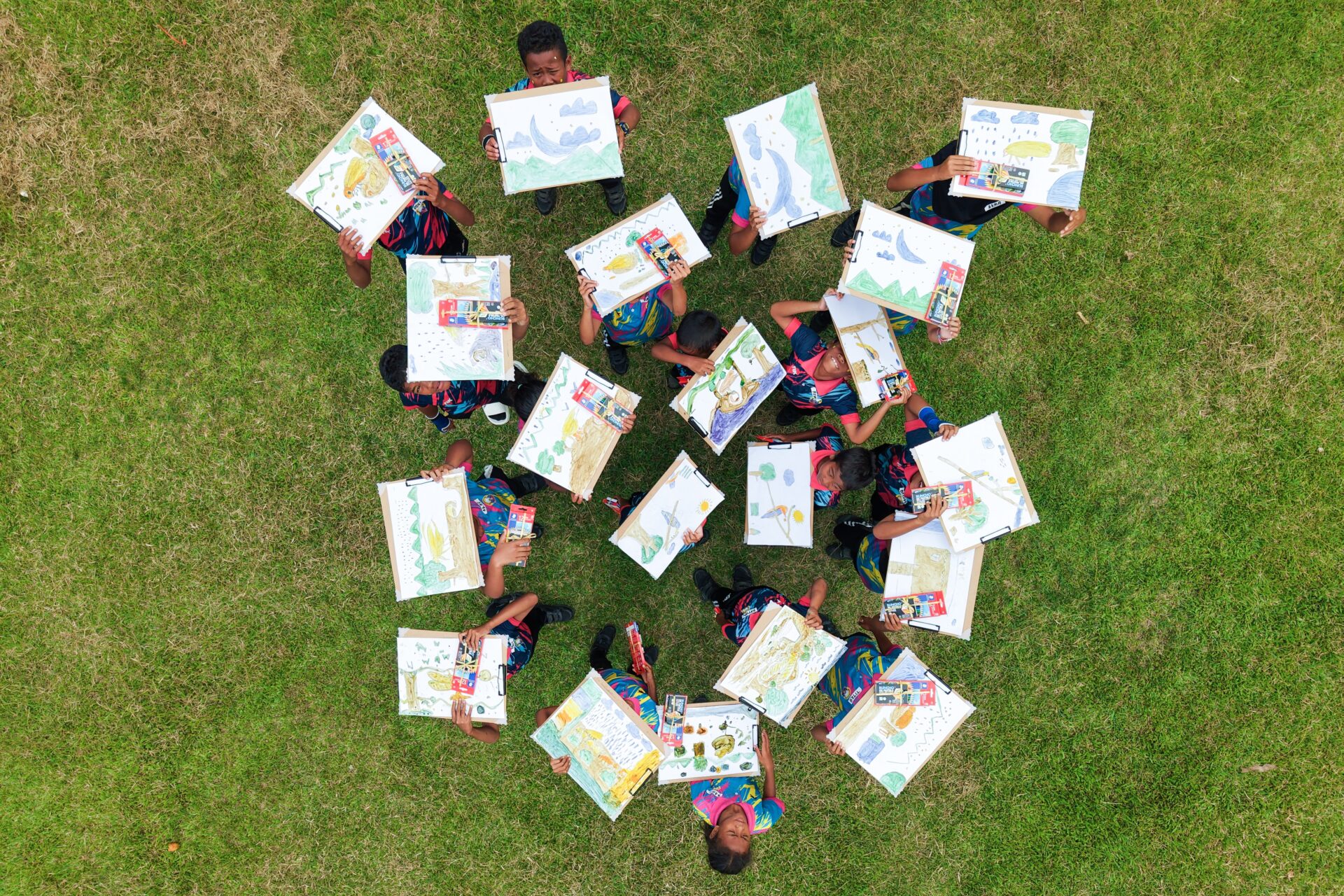
Some of the participating children proudly displayed their completed drawings at the end of the workshop.
To conclude, the first component of creative and arts-based fieldwork provided a valuable opportunity to explore the intergenerational transmission of traditional ecological knowledge and climate change awareness among children. The visits to schools and villages offered more than just ‘data’; they allowed the team to listen, learn, and build trust with the indigenous communities. The fieldwork served a dual purpose, as the team also gained a deeper appreciation of how traditional ecological knowledge is passed down across generations.
Following this initial component, the team will carry out similar activities in the remaining nine partner schools located in the states of Johor and Pahang, Malaysia.